Home › Chilli Growing Guide › Reference
The Scoville Scale and Chilli Heat Chart
From sweet, mild Anaheims to wrinkled superhots, chillies come in an astonishing spread of colours, shapes and heat. Every variety you can grow belongs to one of five cultivated species (C. annuum, C. chinense, C. baccatum, C. pubescens and C. frutescens), and knowing which is which tells you a lot about how it will cope with a British summer. Browse our A–Z of Chillies of UK favourites, filter by heat, and find the right chilli for your windowsill, patio or greenhouse.
KEY FACTS
Measured in: Scoville Heat Units (SHU)
Mildest: sweet bell peppers at 0 SHU
Extreme / Superhot: 350,000 SHU and above, up to 2,200,000+ for the Carolina Reaper
Easiest for beginners: Capsicum annuum types
Handle hot chillies with care. Wear gloves when picking, cutting or deseeding anything from habaneros upwards, keep your hands away from your eyes, and keep superhots well away from children and pets.
1. Understanding the Scoville scale
The Scoville scale measures how hot a chilli is by the amount of capsaicin it contains, the compound that creates the burning sensation. It was devised by the American pharmacist Wilbur Scoville in 1912, using panels of tasters who diluted chilli extract until the heat could no longer be detected. Today laboratories measure capsaicin directly, but the results are still expressed in Scoville Heat Units (SHU), running from zero for a sweet pepper to around 16 million for pure capsaicin.
Treat any Scoville figure as a range rather than a fixed number. Heat varies between plants of the same variety and is strongly influenced by growing conditions: warmth, sunlight, watering and stress all play a part. Chillies grown in a cool, cloudy British summer are often a little milder than the same variety grown somewhere hotter, while a dry, sunny spell can push the heat up.
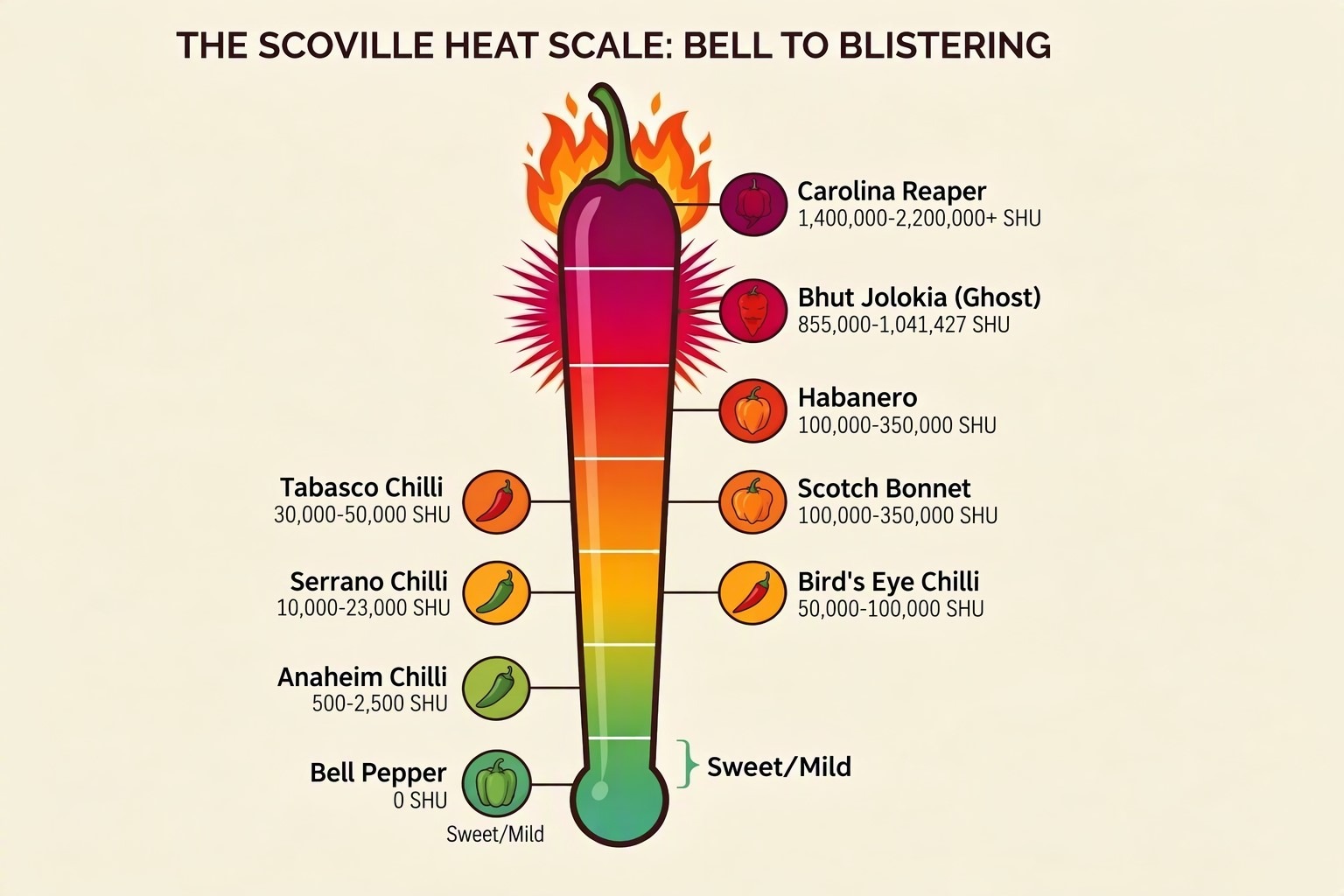
2. Scoville heat chart
| Heat level | Scoville Heat Units | Example varieties |
|---|---|---|
| Sweet / Mild | 0 – 2,500 | Bell Pepper (0 SHU), Anaheim Chilli (500 – 2,500 SHU) |
| Medium | 2,500 – 30,000 | Serrano Chilli (10,000 – 23,000 SHU) |
| Hot | 30,000 – 100,000 | Tabasco Chilli (30,000 – 50,000 SHU), Bird’s Eye Chilli (50,000 – 100,000 SHU) |
| Very hot | 100,000 – 350,000 | Habanero (100,000 – 350,000 SHU), Scotch Bonnet (100,000 – 350,000 SHU) |
| Extreme / Superhot | 350,000 and above | Bhut Jolokia (Ghost) (855,000 – 1,041,427 SHU), Carolina Reaper (1,400,000 – 2,200,000+ SHU) |
3. Choosing for your space
On a sunny windowsill, compact C. annuum varieties such as Apache, Bird’s Eye and Medusa are the most reliable choices, as they stay small and crop well in pots (see final pot sizes for chillies). A sheltered patio suits Jalapeño, Cayenne, Serrano, Padrón and Hungarian Hot Wax through the warmer months, especially in a sunny, south-facing spot.
Rocotos are the exception to the rule that hotter chillies need more warmth. They love cool nights and dislike intense greenhouse heat, which can cause flower drop, so large outdoor pots in a sheltered spot usually suit them best through a British summer. They are also one of the easiest types for overwintering chilli plants indoors.
The hotter C. chinense varieties, from Habanero and Scotch Bonnet up to the superhots, need a long, warm season, so a greenhouse or polytunnel and an early start make all the difference. Check the UK Growing Calendar for sowing times, and read Choosing your varieties for help building a balanced collection. The RHS guide to growing chilli peppers also highlights varieties that have earned the RHS Award of Garden Merit.